REVIEW · PHILADELPHIA
Historic Sites of Philadelphia Self-Guided Walking Audio Tour
Book on Viator →Operated by WalknTours · Bookable on Viator
A Revolutionary War walk that’s easy to steer.
This self-guided audio tour pairs free outdoor landmarks with smart phone navigation, so you can explore Independence-era Philly without racing a group. I like that it keeps you moving from place to place with short stops, and I especially like the audio moments with music at key locations. One thing to consider: you’ll want earbuds, because listening on speakers can be tough in public.
You’ll start at Elfreth’s Alley Museum and work your way through the Revolutionary core—Washington, Franklin, Hamilton, and the places where the founding fathers argued and planned. The tour is designed to be flexible, with prompts that help you pause and regroup, then hop to the next stop when you’re ready. The trade-off is that it’s not a deep, slow, human-led lecture—some details are brief, so if you want long-form context, you may want to add a paid entrance or a guided tour later.
In This Review
- Key highlights you’ll actually feel on the walk
- Why this self-guided Revolutionary War walk works in Philadelphia
- Price and value: what $9.49 buys you (and what it doesn’t)
- Getting started: Elfreth’s Alley Museum and the app-navigation trick
- Stop 1: Elfreth’s Alley—keeping your first feet in the 1700s
- Stop 2: outside the Betsy Ross house—flag story plus music
- Stop 3: Benjamin Franklin’s grave—French alliances and a sharp brain
- Stop 4: the Synagogue of the Revolution—Haym Solomon’s financing story
- Stop 5: The President’s House—where Washington lived, plus the Town Killer nickname
- Stop 6: Liberty Bell Center—what it meant before and after
- Stop 7: Independence Hall—outside viewing now, paid entry if you want more
- Stop 8: Signer’s Garden—George Clymer and the idea of risk
- Stop 9: Carpenters’ Hall—craft guild politics and the Birthplace of Liberty
- Hamilton’s trail: First Bank, Maria Reynolds scandal, and a final food-and-drink landing
- Who this tour fits best (and who might want something else)
- Practical tips to make your Revolutionary walk feel smooth
- Should you book this Philadelphia audio walking tour?
- FAQ
- How long is the Historic Sites of Philadelphia self-guided walking audio tour?
- Where does the tour start and end?
- Is there a human guide on this tour?
- Is Independence Hall included inside, or is it only outside?
- Are the stops along the route free to view?
- What language is the audio available in?
- Is it private for your group?
- What’s the cancellation policy?
Key highlights you’ll actually feel on the walk
- Phone-in-pocket navigation with an on-screen arrow if you drift off the route
- All-outside viewing for most stops, with Independence Hall entry optional
- Music included at a couple of stops, not just spoken narration
- Pace control: pause when you want photos, then press on
- Hamilton stops tied to real Revolutionary-era finance and scandal
- Finishes at City Tavern, a fitting landing spot for the founding-fathers vibe
Why this self-guided Revolutionary War walk works in Philadelphia
Philadelphia is packed with famous sites, and that’s the problem: you can spend your whole day “getting there” and still feel like you missed the point. A self-guided audio format fixes that. You choose your pace, and you’re not stuck waiting for a group to emerge from a museum line.
This tour also makes a smart bet: it focuses on the tight, walkable Revolutionary cluster where you can see a lot from the sidewalk. Most stops are free to view, so your money stays in your wallet and your time stays on your feet.
And because it’s built for the WalknTours app, you’re not guessing at what comes next. That matters when you’re trying to keep the day fun, not stressful.
Other historic Old City walking tours we've reviewed in Philadelphia



Price and value: what $9.49 buys you (and what it doesn’t)
At $9.49 per person, this is priced like a low-friction add-on, not a premium guided experience. That’s a good thing—because you’re not paying for an attendant; you’re paying for navigation and audio storytelling.
Here’s the value math that makes sense: the itinerary hits major Revolutionary landmarks like Independence Hall (outside), Liberty Bell Center, Carpenters’ Hall, and more, and the tour itself lists free admission for the stops you’ll stand at. If you were to pay for multiple separate museum tickets just to “feel informed,” it adds up fast. This keeps you oriented without forcing you into paid entry.
What you don’t get is a human guide who can answer your questions on the fly or expand on obscure tangents at length. If you’re hoping for a super-detailed, slow-burn lecture, you might find the audio segments shorter than you want. But for a first pass, it’s a cost-effective way to build context quickly.
Getting started: Elfreth’s Alley Museum and the app-navigation trick

Your walk begins at Elfreth’s Alley Museum, 126 Elfreth’s Alley. From there, you press start and then put your phone away while the audio guides you. The app’s “keep you on track” feature is the key practical benefit: if you feel off route, you can check the arrow in the app to point you toward the next stop.
This approach is more useful than it sounds. Philadelphia streets can be confusing if you’re bouncing between famous corners, and it’s easy to waste time standing there, checking maps, then losing your place. The WalknTours system is designed to reduce that friction.
One more practical note: you’ll want earbuds (or at least headphones). There’s enough ambient street noise that audio can get hard to hear without them, especially when you’re moving between corners.
Stop 1: Elfreth’s Alley—keeping your first feet in the 1700s
Elfreth’s Alley is named after Jeremiah Elfreth, an 18th-century blacksmith. The big appeal of starting here is that the alleyway still looks and feels like a slice of the Revolutionary-era city—so you get a “before you zoom ahead” moment that sets the tone.
It’s also a good warm-up stop because it teaches you how the tour will behave: short audio segments, quick repositioning, and then the next landmark. Expect about five minutes here, with the idea that you’ll keep moving while the story forms a timeline in your head.
Stop 2: outside the Betsy Ross house—flag story plus music
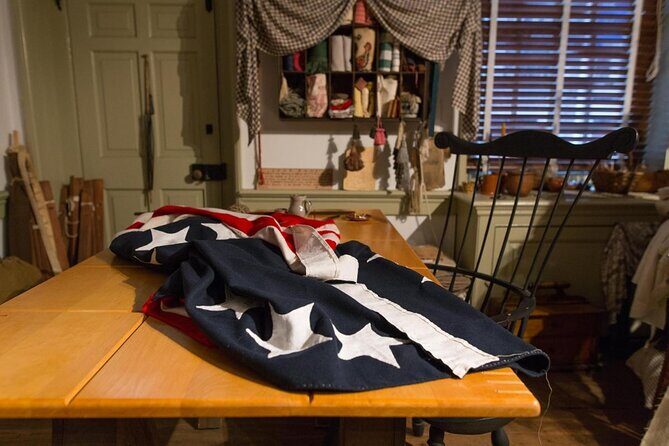
The next highlight is the stop outside the Betsy Ross house. The audio focuses on the story of how Betsy Ross met with George Washington and designed the American flag. Whether you already know the tale or you’re meeting it for the first time, this is the kind of story that’s easy to connect to the bigger political stakes—because it’s about symbols that traveled far beyond the streets you’re standing on.
One reason this stop works: the audio includes music, which makes it feel like more than facts read aloud. It also gives you a quick, memorable “pause point” where you can watch the street life around you for a minute and still feel like you’re part of the scene.
Other self-guided and audio tours we've reviewed in Philadelphia






Stop 3: Benjamin Franklin’s grave—French alliances and a sharp brain
At Benjamin Franklin’s grave, you’re not just told that Franklin mattered—you’re guided through how he helped drive the Revolution forward, including his partnership with French allies. This is a useful stop because the Revolution isn’t only soldiers and battles. It’s also diplomacy and money, and Franklin fits that whole web.
If you want the day to feel less like name-dropping, this is where it starts to click. Franklin comes across as energetic and strategic, not just “the guy on the hundred.”
Stop 4: the Synagogue of the Revolution—Haym Solomon’s financing story
Next you’ll stop at the synagogue known as the Synagogue of the Revolution. The audio spotlights Haym Solomon, a financier of the Revolution. This is one of those details that changes how you view the whole period: revolutions run on more than speeches—they need credit, trust, and supply chains.
This stop also features great music, which helps the story land emotionally instead of feeling like a quick history quiz.
Stop 5: The President’s House—where Washington lived, plus the Town Killer nickname

The tour then heads to the President’s House spot, the place where George Washington lived. The audio lesson here is partly about daily reality—what it means for the new country to center power in a real home—and partly about personality, including Washington’s nickname Town Killer.
That nickname is the kind of detail you can easily miss if you only stick to the most standard big-tour explanations. It adds a little edge, because it hints at how complicated leadership can be during a tense period.
Stop 6: Liberty Bell Center—what it meant before and after
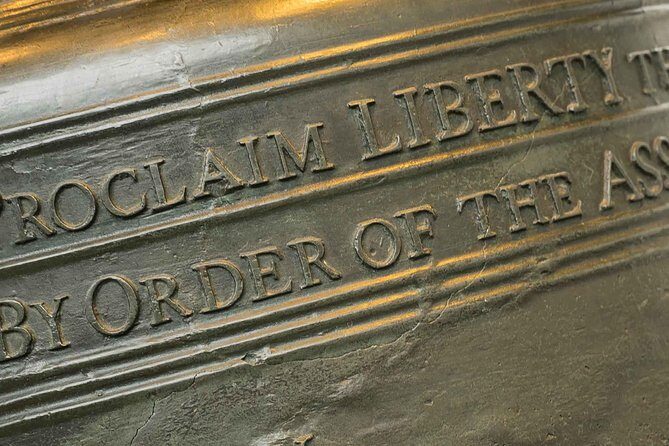
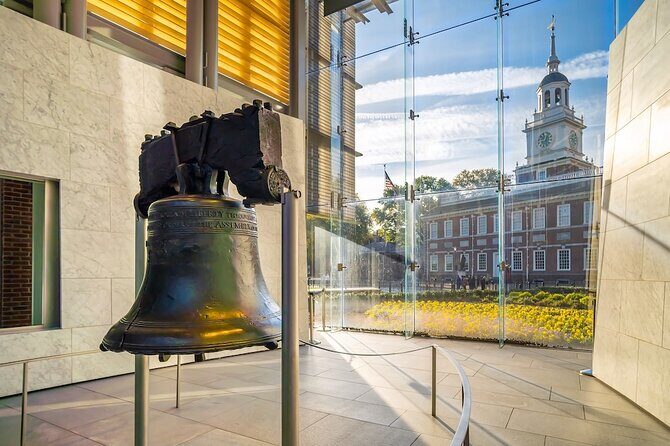
At Liberty Bell Center, you’ll see the bell and hear how it became more than a piece of metal. During the Revolution, the bell was reportedly hidden in Allentown, and after the Revolution it became a symbol of liberty.
This stop is a strong mid-tour reset. You get a big, world-famous object, but the audio helps you understand why it matters historically, not just visually. Also, it’s a convenient timing feature: the tour lists a short stop here, so you don’t get stuck watching crowds and losing the arc of the day.
Stop 7: Independence Hall—outside viewing now, paid entry if you want more
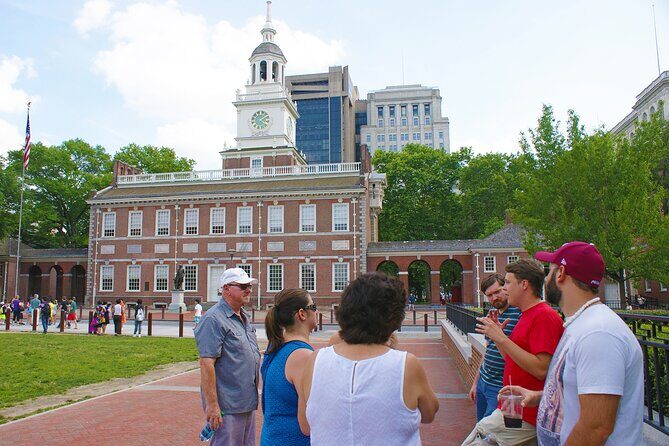
The tour stops at Independence Hall from the outside. You’ll learn the name was connected to the Marquis de Lafayette and his visit to the state house, when he called it the Hall of Independence.
Inside, Independence Hall is where key founding debates happened, including the adoption of the Declaration of Independence and the United States Constitution. But here’s the practical part: if you want to go inside, you need to book an entrance ticket. The tour itself does not include entry.
This is a smart way to do it. You still get the orientation and context from the sidewalk, then you can decide on the spot whether it’s worth your time to pay and enter. For short on time days, sticking to outside viewing is a win.
Stop 8: Signer’s Garden—George Clymer and the idea of risk
Next comes Signer’s Garden. The story centers on the statue in the center that recognizes the spirit and risks taken when the Declaration was signed. The statue is of George Clymer, a local merchant and politician.
This stop helps you shift from “heroes and headlines” into the harder side of politics—people signing papers knowing there could be consequences. Even if you’ve seen photos of this area before, the audio framing makes it feel more personal and less ceremonial.
Stop 9: Carpenters’ Hall—craft guild politics and the Birthplace of Liberty
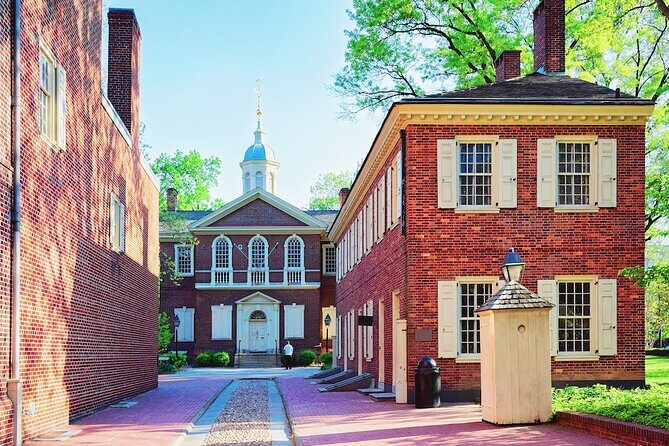
At Carpenters’ Hall, you’ll learn that it was built for and is still owned by the Carpenters company of Philadelphia, the country’s oldest craft guild. The audio also calls it the Birthplace of Liberty.
This is where the tour earns points for going a little off the usual checklist. You’ll hear how rebels met here and boycotted the British, plus a surprising detail: Quebec almost became one of the original colonies. It’s the kind of “wait, really?” moment that makes self-guided audio feel worth it instead of repetitive.
Carpenters’ Hall is also a good “brain stretch” stop because it broadens the story beyond politicians. The Revolution needed tradespeople and organizing too.
Hamilton’s trail: First Bank, Maria Reynolds scandal, and a final food-and-drink landing
After the Carpenters’ Hall stop, the audio shifts into Alexander Hamilton territory with two key locations.
First, you’ll hear about the First Bank of the United States, described as the cornerstone of Hamilton’s fiscal policy. The audio notes it operated from 1791 to 1811 and explains Hamilton’s argument for a national bank—helping stabilize and improve the nation’s credit and improving how the government handles financial business under the newly enacted Constitution.
Second, you’ll move to the spot where Hamilton once lived, including mention of the scandal involving Maria Reynolds and how it ended his career. This portion works best if you’re curious about how public life and personal life collided in the early republic. It’s human drama layered onto political history.
The tour then ends back at the City Tavern (Museum) on S 2nd St. The audio framing brings you to the place where the founding fathers feasted and gives you a natural “wrap up” feeling at the end of the walk.
Who this tour fits best (and who might want something else)
This walk is best for you if:
- you want a cheap, flexible way to hit major Revolutionary sites in about 1 hour to 1.5 hours
- you like learning through short story segments rather than long lectures
- you prefer control: pause for photos, step aside, and keep moving when you’re ready
It may be less ideal if:
- you want deep, slow explanations for every landmark
- you’re traveling with kids who get bored if an audio segment feels too brief
- you dislike phone-based navigation and want a person to answer questions constantly
That last point is worth taking seriously. This is solo, app-led, and it depends on you engaging with the audio.
Practical tips to make your Revolutionary walk feel smooth
A few small adjustments can make a big difference.
Bring earbuds/headphones.
Even the strongest audio loses impact without them, and Philadelphia is noisy. If you forget yours, you might need to buy something locally.
Wear shoes you can trust.
Most of the tour is quick, and the stops are close enough that you’ll keep walking between them. Comfortable shoes help you avoid the “too-tired-to-care” problem.
Plan your day around focus.
Because this is a tight arc, it’s easiest when you treat it like your main activity for a short window. If you want to wander off into nearby areas, you can, but you’ll come back and rejoin the story where you left it.
Don’t expect paid museum time baked in.
Most stops are outside and listed as free viewing. If you want Independence Hall inside access, you’ll need to arrange that separately.
If you’re picky about route details, double-check your starting spot.
The tour begins at Elfreth’s Alley Museum and ends at City Tavern, so keep those addresses handy so you don’t waste time hunting.
Should you book this Philadelphia audio walking tour?
Yes—if your goal is a low-cost, high-impact overview of Revolutionary Philadelphia that fits into a short day. For $9.49, the balance is strong: you get turn-by-arrow navigation, a clear set of landmarks, and stories that cover more than the biggest-name stops. The Hamilton segments alone help make it feel more than a generic “big sites” walk.
I’d hesitate if you want long, deep explanations or you hate phone audio navigation. In that case, you might be happier pairing a guided tour with a short self-guided add-on.
If you’re doing Philadelphia for the first time and you want to leave with names, connections, and context—and not a dent in your schedule—this one is a solid pick.
FAQ
How long is the Historic Sites of Philadelphia self-guided walking audio tour?
It’s listed as about 1 hour to 1 hour 30 minutes.
Where does the tour start and end?
It starts at Elfreth’s Alley Museum, 126 Elfreth’s Alley, Philadelphia, PA 19106, and ends at City Tavern (Museum), S 2nd St, Philadelphia, PA 19106.
Is there a human guide on this tour?
No. It’s a solo tour guided by the WalknTours app.
Is Independence Hall included inside, or is it only outside?
The tour goes outside. Independence Hall entrance is not included, and if you want to go in you’ll need a ticket on your own.
Are the stops along the route free to view?
The stops listed for viewing are marked as free (with the only outside entry limitation specifically called out for Independence Hall).
What language is the audio available in?
The tour is offered in English.
Is it private for your group?
Yes. It’s listed as a private tour/activity, so only your group participates.
What’s the cancellation policy?
Free cancellation is available up to 24 hours in advance for a full refund.