REVIEW · PHILADELPHIA
Philadelphia Historic Sites Self-Guided Walking Tour
Book on Viator →Operated by Action Day Trips · Bookable on Viator
Philly’s Founding Sites, narrated as you walk. This GPS-triggered audio tour lets you pace yourself through key historic stops with offline maps after download, all for $14.99 and about 1 to 2 hours. I especially like the hands-free, location-based storytelling and the way it helps you connect names to places without staring at a phone constantly. One drawback to factor in: several stops have separate admission, so you’ll still want to budget a little if you plan to go inside.
The big value here is flexibility. You can start when you want, pause for snacks or photos, and come back later since access is lifetime with no expiry. Just remember: you’ll need a strong Wi-Fi/cellular spot to download the tour first, or the offline experience won’t be ready.
In This Review
- Key highlights before you start
- Why $14.99 for a lifetime audio walk makes sense
- Getting started: City Hall address, password, and offline download
- My quick on-the-ground tip
- How long it really takes: 1–2 hours, 1.5 miles, and smart pacing
- Liberty Bell Center: freedom slogans and why it cracked
- Betsy Ross House and Christ Church: the flag story and the Sunday service link
- City Hall and Revolutionary-era planning grounds
- Independence Square and Independence Hall: Congress, votes, and the Declaration in place
- Bonus detail I’d encourage you to notice
- West Washington Square and the First Continental Congress site
- Benjamin Franklin Museum, the President’s House, and the Declaration House
- African American Museum in Philadelphia: slavery’s impact and key names
- Franklin Square, Bolt of Lightning Memorial, and the meaning behind money
- National Constitution Center, Franklin’s grave, and Elfreth’s Alley
- Wrapping up at Christ Church and near the Museum of the American Revolution
- Who this Philly historic sites walking audio tour is best for
- Practical value checklist: what to budget and how to plan your visit
- Should you book this self-guided Philadelphia historic sites tour?
- FAQ
- How long is the Philadelphia Historic Sites self-guided walking tour?
- Does it work without cell service or Wi-Fi?
- Are admission tickets included for all stops?
- Where do I start and where does the tour end?
- Can I use the same password on more than one device?
- Is free cancellation available?
Key highlights before you start
- GPS audio that plays automatically as you approach each location, so you don’t need constant tapping.
- Offline-ready maps and audio after the initial download.
- 30+ audio stories over about 1.5 miles, usually finishing in 1–2 hours.
- Lifetime access with no expiry, useful on repeat trips.
- Many famous stops are listed with free admission tickets, while others aren’t included.
Why $14.99 for a lifetime audio walk makes sense

At $14.99 per person, this Philadelphia Historic Sites self-guided walking tour is priced like a good meal, not a big guided-group splurge. You’re paying for a structured route, a professional audio script, and the convenience of not having to coordinate a schedule with strangers.
The lifetime access is a big deal. You can use it on your next Philadelphia weekend, or you can restart from the beginning when your schedule is tighter than planned. That also means you’re not “wasting” money if you run out of energy at Stop 10 and need to call it a day.
Where value can wobble is admissions. Some stops are marked as free, while others are not included. So I treat this as a great audio orientation walk first, then a choose-your-own-adventure for indoor sites.
Other historic Old City walking tours we've reviewed in Philadelphia



Getting started: City Hall address, password, and offline download
You start at Philadelphia City Hall, 1400 John F Kennedy Blvd, Philadelphia, PA 19107. The tour ends near the Museum of the American Revolution, 101 S 3rd St, Philadelphia, PA 19106.
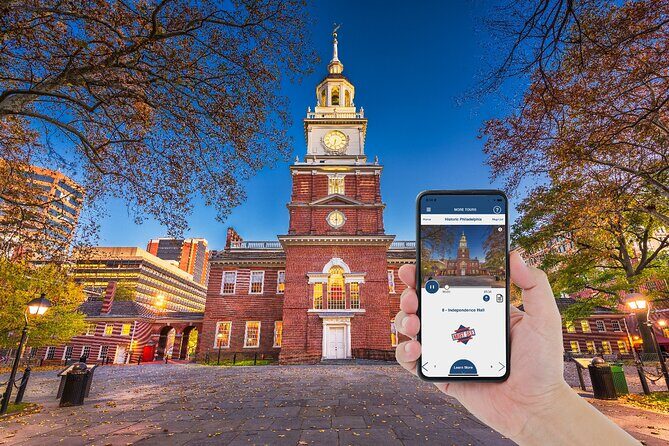
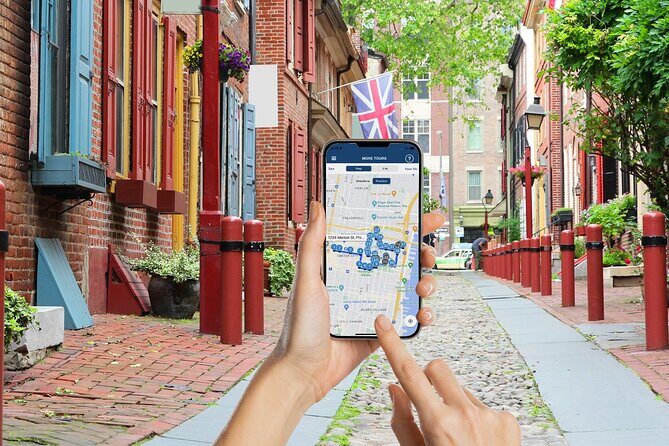
No guide meets you. After booking, you get an email/text with setup steps and a password. Then you download Action’s separate tour app (Action’s Tour Guide App). The key practical point: you must download the tour while you’re on strong Wi-Fi/cellular. After that, it’s designed to work without signal.
When you’re onsite, open the app and start the story at the first location. The audio should begin automatically, then continue based on where you are. If you’re traveling with multiple devices, the same password can be used on as many devices as you booked for your group.
My quick on-the-ground tip
Bring earbuds. The app recommends headphones/earbuds for the best experience, especially outdoors where street noise is real.
How long it really takes: 1–2 hours, 1.5 miles, and smart pacing
The route is about 1.5 miles long, with more than 30 audio stories, and it typically takes about 1–2 hours. Each stop has a rough time expectation (often around 5–10 minutes), but you’ll control the pace because you can pause and restart.
This is one of those tours that rewards not rushing. A couple of practical reasons:
- If you keep moving at a fast clip, audio may start overlapping before a previous segment fully finishes.
- If you pause to read small plaques or look at street-level details, you’ll get more out of each story beat.
Also note the practical “walk reality.” Even if the official walk is around 1.5 miles, you might add extra steps from sidewalks, crossings, or detours around buildings. Build in a little buffer, especially if you’re doing it in hot weather or rain.
Liberty Bell Center: freedom slogans and why it cracked
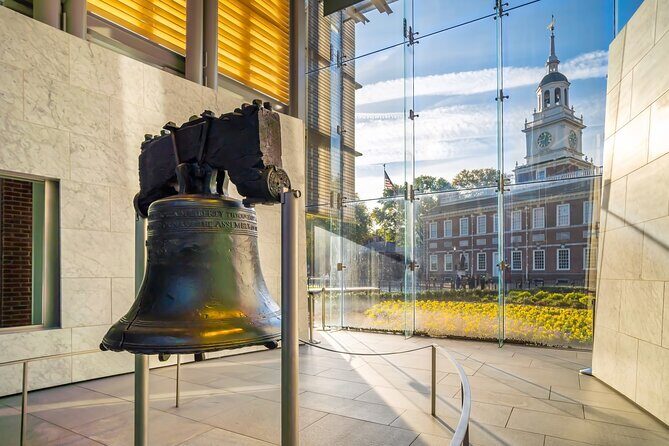
Your first stop is the Liberty Bell Center, with the audio focused on why this bell became iconic—and why it’s so vulnerable to cracks. You’ll also hear how the bell’s symbolism shifted in later years, connected to Americans fighting for freedom from slavery, equal voting rights, and what people mean by liberty.
What I like about starting here is momentum. The Liberty Bell is the easiest “anchor image” for the rest of the walk. By the time you reach Independence Hall and Congress sites, the stories feel less like random landmarks and more like connected chapters.
This stop is listed with an admission ticket free note. That matters because it lets you prioritize learning first, rather than immediately making a pay-or-skip decision.
Other self-guided and audio tours we've reviewed in Philadelphia





Betsy Ross House and Christ Church: the flag story and the Sunday service link
Next comes the Betsy Ross House, where the audio takes you back to the American flag’s early story. The focus isn’t just on the flag as an icon; it also ties it to Betsy Ross and her fateful meeting with George Washington during Sunday service at Christ Church.
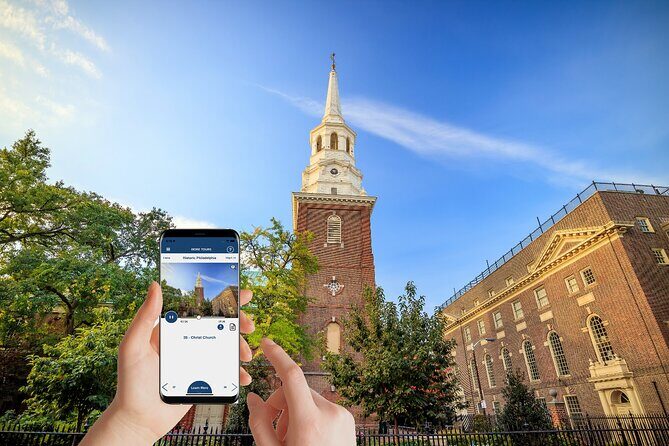
Then you’ll walk to Christ Church, where the audio highlights Revolutionary-era worship and the overlap of big names like George Washington and Betsy Ross. You also get a sense of the building itself—its historical role and its standout architecture.
Here’s the catch: Betsy Ross House and some other stops are marked as admission not included. So if you want to go inside, plan to pay separately. If you mostly want the exterior context and audio storytelling, you’ll still get a strong experience.
City Hall and Revolutionary-era planning grounds
As you move toward City Hall, the audio frames Philadelphia in the Revolutionary period. You’ll hear about the foundations of the Revolutionary War, and how figures like George Washington and Benjamin Franklin had deep roots here.
City Hall is listed as admission not included, so again: decide ahead of time how much you want to spend on indoor access. If you’re on a tight budget, treat this as a “listen and look” stop, not a ticket stop.
The route then pulls you toward Independence Square and the wider Congress area. This section is where the audio starts connecting the political machinery—meetings, votes, and planning—to the physical geography of downtown Philadelphia.
Independence Square and Independence Hall: Congress, votes, and the Declaration in place

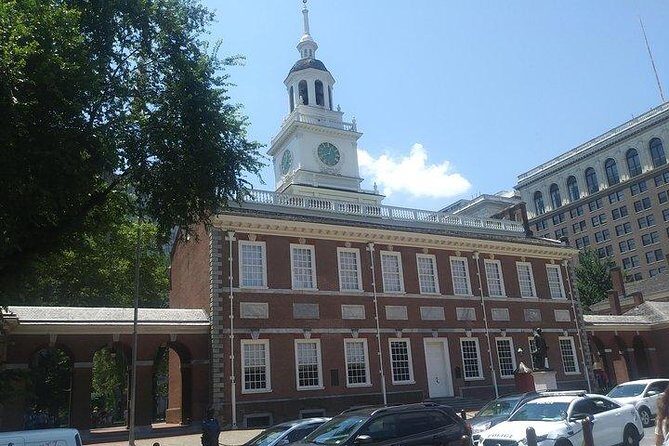
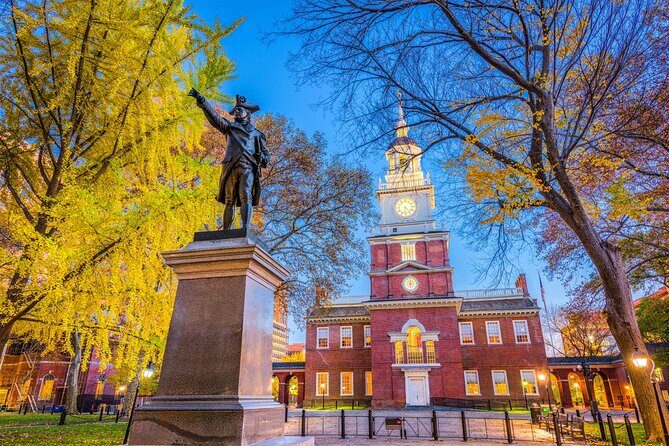
Independence Square is one of your most important landmarks, and the audio doesn’t just name it—it explains what happened there. You’ll hear how the First Continental Congress unified the colonial states, how military revolts and battles against the British were planned, and how the Second Continental Congress gathered votes from across the colonies.
This is also where the Declaration of Independence is tied to the moment America came to life. The audio adds recognizable figures like John Hancock, Patrick Henry, and John Adams, plus how colonial Americans would have interpreted Independence Hall versus how modern Americans read it.
This is listed with a free admission ticket note at this stop. That’s great because you can spend your money on other parts of the city without feeling like the tour is forcing paid entries.
Bonus detail I’d encourage you to notice
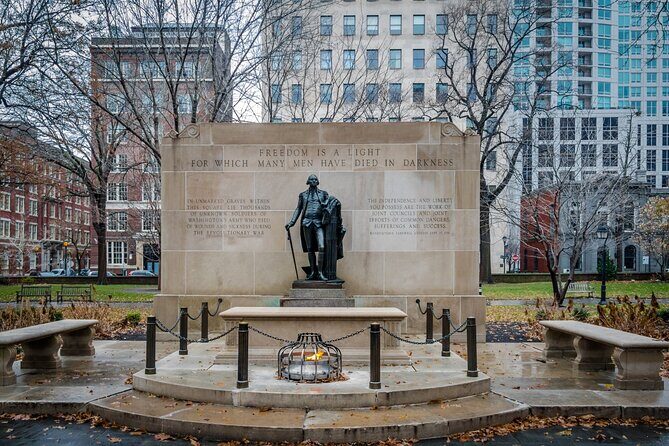
The tour includes George Washington’s statue outside nearby sites. Even if you only glance at it, the audio context helps you see it as more than a photo backdrop.
West Washington Square and the First Continental Congress site
A short stop next: West Washington Square. Here, the audio points you to a key location tied to the First Continental Congress. It’s brief on time, but it’s useful because it helps you understand what came before the bigger Independence Hall storyline.
Stops like this are why a self-guided audio format works. A human guide might rush past a “small” corner, but the audio gives it a proper meaning—then moves you forward when you’re ready.
This stop is listed as free, so it’s a low-cost add-on to your learning.
Benjamin Franklin Museum, the President’s House, and the Declaration House
Now the walk leans into people—their ideas and their compromises.
You’ll pass Benjamin Franklin Museum, where the audio emphasizes his variety of interests, his personality, and the way his knowledge shows up in American life. Then it shifts to the anti-hero story: Benedict Arnold, and what his plans were.
Next comes the President’s House, described as the original presidential home of George Washington and later John Adams. The audio uses it to explain what presidential life looked like in the colonial era—smaller scale than what most people imagine today.
Then you reach Declaration House (also tied to the Graff House), where the audio focuses on Thomas Jefferson writing the Declaration of Independence and how Ben Franklin helped edit it. You’ll get a short narrative “in the footsteps” experience, connecting the paperwork to the room it was shaped in.
Important practical note: the Franklin Museum and both the President’s House and Declaration House are marked as admission not included. So this is the part of the route where you’ll most likely decide what to pay for versus what to experience from the sidewalk.
If you’re the type who loves reading plaques and watching people flow through historic districts, you’ll still enjoy these stops even without indoor entry.
African American Museum in Philadelphia: slavery’s impact and key names
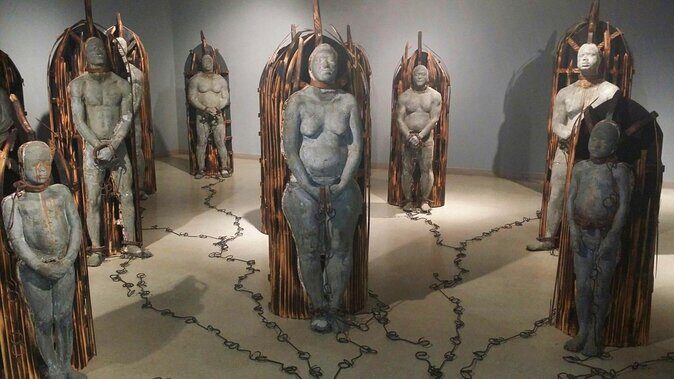
This is an essential stop on the route. The audio addresses how freedom in early America was not evenly applied—especially when it came to African-Americans—and it connects that to the museum you pass.
The audio also names historic contributions, including Crispus Attucks, and frames slavery’s impact as part of Philadelphia’s larger story.
I value this section because many quick “founding sites” walks tell the success story only. Here, the tour keeps the historical record front and center while you’re already in the middle of the Declaration and Congress settings.
The museum stop is marked as admission not included, which means you’ll probably want to check ahead if you’re planning to enter.
Franklin Square, Bolt of Lightning Memorial, and the meaning behind money
After the heavy political and moral questions, the audio brings you back to Franklin’s world of experiments, ideas, and public life.
You’ll reach Franklin Square, where the audio ties Franklin’s bookish side and experiments into the broader Independence-era story. Then comes the Bolt of Lightning Memorial to Benjamin Franklin, focused on what Franklin was discovering, why he wanted to try it, and how he planned to do it.
From there, you pass the United States Mint. The audio explains the early economy using gold and silver coins, and it also touches on copper, nickel, and paper money today.
This part works well for a few reasons:
- It breaks up the intense “Revolution speeches” rhythm.
- It shows that the founding era wasn’t only politics; it was technology and everyday systems too.
- It gives you a tangible link between symbols and the materials people used.
Both Franklin Square and the lightning memorial are listed with free admission ticket notes. That’s helpful because you can enjoy them without another paywall decision.
National Constitution Center, Franklin’s grave, and Elfreth’s Alley
The route continues with the National Constitution Center, where the audio ties Philadelphia to the formal idea of a nation and highlights how citizens’ fundamental rights were guaranteed. That’s a smart follow-up after you’ve heard about Congress and the Declaration, because it adds what came next.
You’ll then pass United States Mint (already covered in feel), and later walk by Benjamin Franklin’s Grave. The audio connects Franklin’s legacy to the University of Pennsylvania and explains how UPenn reflects Franklin’s ideals for the next generation. It’s a short moment, but it’s one of those “wait, that connection makes sense” stops.
Finally, you reach Elfreth’s Alley. The audio frames it as a historical street with deep roots in the early downtown area, and yes, it’s also modern-photo friendly.
One practical note: the Constitution Center and many of the other museum-style stops are marked admission not included. If you want to go in, you’ll need separate tickets. But even without entry, the audio helps you understand what each place represents.
Wrapping up at Christ Church and near the Museum of the American Revolution
You’ll return to Christ Church area once more (the audio points you to its significance for Revolutionary-era figures and the architecture). Then your route ends near the Museum of the American Revolution, giving you a natural “if you’re hungry for more” option.
The route is designed to finish here so you can keep exploring on your own, or step into a major museum if you didn’t get your fill earlier. If you’re short on time, ending near the museum still gives you a strong last context window—especially after hearing about Congress, the Declaration, the Constitution, and Franklin.
Who this Philly historic sites walking audio tour is best for
This is a strong fit if you:
- Like exploring at your own pace rather than being pulled along by a group.
- Want a fast route through major landmarks with clear storytelling.
- Travel with a mix of interests—politics, famous people, and the “how did this country work” side.
It can also work well for couples, because the tour info notes that couples can share one tour by splitting headphones.
If you hate walking, or if you strongly prefer fully guided group explanations with live back-and-forth, you might find the audio format less satisfying. The route is short-ish, but it still expects you to cover about 1.5 miles and keep moving between stops.
Practical value checklist: what to budget and how to plan your visit
Before you go, I’d plan like this:
- Expect a solid outdoor “orientation” experience built around major places.
- Decide in advance which indoor stops are worth paying for, since several are marked admission not included.
- Download the app on strong Wi-Fi before you start, so you don’t waste time once you’re in the historic district.
- Bring earbuds and expect about 1–2 hours total for the full walk at a normal pace.
Also, if your phone battery runs low, this tour can still save you because you can pause and take breaks. Still, it’s smart to carry a small power bank if you’re a heavy phone user.
Should you book this self-guided Philadelphia historic sites tour?
Yes, I’d book it if you want a structured, time-efficient way to connect the Liberty Bell, Independence Hall area, Franklin sites, and key Revolutionary-era stories in one walking loop. The offline-ready GPS audio and lifetime access make it a good deal for return trips, and the mix of politics plus people (and even money and science) keeps it from feeling one-note.
Skip it or adjust expectations if you need a live guide, or if you’re hoping every stop is included admission-free. This tour is at its best as a narrated walk that tells you why places matter—then lets you choose what to pay to enter.
FAQ
How long is the Philadelphia Historic Sites self-guided walking tour?
The tour takes about 1 to 2 hours, and it’s roughly 1.5 miles long. It includes more than 30 audio stories, with stops designed for short listening windows.
Does it work without cell service or Wi-Fi?
Yes. You need to download the tour while you’re on strong Wi-Fi or cellular. After that, the tour works offline with offline maps and GPS-based audio.
Are admission tickets included for all stops?
No. Some stops are marked with Free admission ticket, while others are marked as Admission Ticket Not Included. You may need to buy separate tickets if you want to enter those places.
Where do I start and where does the tour end?
It starts at Philadelphia City Hall, 1400 John F Kennedy Blvd, Philadelphia, PA 19107. It ends near the Museum of the American Revolution, 101 S 3rd St, Philadelphia, PA 19106.
Can I use the same password on more than one device?
Yes. Your password can be used on the same number of devices as the travelers you booked. Enter the same password on each device.
Is free cancellation available?
Yes. Free cancellation is available up to 24 hours in advance for a full refund, and within 24 hours the amount paid is not refunded.