REVIEW · PHILADELPHIA
Solve the Case: Self-Guided Mystery Puzzle Walk in Philadelphia
Book on Viator →Operated by Questo · Bookable on Viator
A phone turns Philadelphia into a puzzle. This self-guided walk nudges you from landmark to landmark with on-screen clues and a story that grows as you solve each step. You’ll stop at places like the Liberty Bell and Reading Terminal Market, plus quieter history stops that most people breeze past.
I like the flexible format: start anytime, pause, then jump back in. I also like that the whole thing is built for real streets—step-by-step directions to each location, and you can even play offline while you’re walking around.
One caution: it’s self-guided, so there’s no physical guide to explain the bigger picture. And one reader flagged a frustrating problem with buying through Viator instead of the Questo app, so I’d be careful about where you unlock your ticket.
In This Review
- Key things to know before you start
- How the Questo case-walk really plays in Philadelphia
- Spruce Street Harbor Park: the Delaware River with a game mission
- Elfreth’s Alley: solving in a street that dates to 1703
- The financial muscle: the Second Bank of the United States
- Independence Hall and the Constitution hub: the most serious stretch
- Independence Hall: where the story is the point
- National Constitution Center: a nonprofit devoted to the Constitution
- Liberty Bell: independence you can see at street level
- Christ Church and Franklin’s burial ground: Georgian architecture and real names
- Christ Church (1695) and the Georgian building
- Benjamin Franklin’s burial site: a cemetery with an extra layer
- Chinatown to Reading Terminal Market: puzzles, food energy, and real community history
- Chinatown: a “bachelor society” origin story at 913 Race Street
- Reading Terminal Market: a grid of stalls opened in 1893
- The African American Museum stop: culture and context in a quick game moment
- Price and timing: why this short mystery walk is good value
- Practical tips so the game doesn’t slow you down
- Who this is best for (and who should skip it)
- Should you book Solve the Case in Philadelphia?
- FAQ
- FAQ
- What is this experience, exactly?
- How long does the walk take?
- How much does it cost?
- Can I play it offline?
- Where does the walk start and end?
- Is there a physical tour guide with you?
- What language is it offered in?
- Is it available at any time?
- Is it suitable for kids?
- Are service animals allowed?
- Can I cancel if my plans change?
Key things to know before you start
- Offline step-by-step directions mean you can wander without relying on cell service.
- Start at Spruce Street Harbor Park and finish at Reading Terminal Market, so the route has a natural flow.
- Puzzle-driven stops turn famous sights (Independence Hall, Liberty Bell) into scavenger hunts.
- Summer-only vibe at Spruce Street Harbor Park: if you go off-season, expect a different feel.
- Free for kids and easy to play in a group, since you’re not tied to a fixed tour time.
- No physical guide: you’ll be reading clues and scanning for answers yourself.
How the Questo case-walk really plays in Philadelphia
This is a self-guided mystery puzzle walk run through the Questo app. You follow prompts on your phone that send you to the next spot, and the game asks you to look around to find an answer before it advances you.
The route is designed for a one-and-a-half-hour outing, roughly 90 minutes. That’s a great length for Philadelphia’s historic core because you get plenty of walking, but you’re not committing to a half-day. And since it’s offered 24/7 every day, you can fit it into almost any itinerary.
The practical win is the navigation. The app gives directions to each destination, and it can work without internet while you’re out exploring. So you’re not stuck in the classic vacation trap of wandering with a spinning loading wheel.
Price-wise, at $7.19 per person, this is a value play. You’re paying for structure and entertainment more than for a human guide. If you’re the type who enjoys “wait, look up there” sightseeing, that structure makes the price feel very fair.
Other self-guided and audio tours we've reviewed in Philadelphia



Spruce Street Harbor Park: the Delaware River with a game mission

Your walk starts at Spruce Street Harbor Park, address 301 S Christopher Columbus Blvd. This place is an urban beach in Penn’s Landing along the Delaware River, with a boardwalk feel that turns sightseeing into a slower, more playful pace.
Here’s the trick: the game doesn’t dump facts in your lap. It pushes you to scan your surroundings to find the challenge answer and move on. That approach can actually make this area more interesting, even if you’ve only got a few minutes before moving deeper into the historic sights.
Practical note: Spruce Street Harbor Park is open during the summer. So if you’re visiting outside that window, you’ll still be in the right starting area, but the “beach” vibe may be muted. Still, the boardwalk setting is a nice way to begin because you’re starting outdoors, not in a museum hallway.
Elfreth’s Alley: solving in a street that dates to 1703
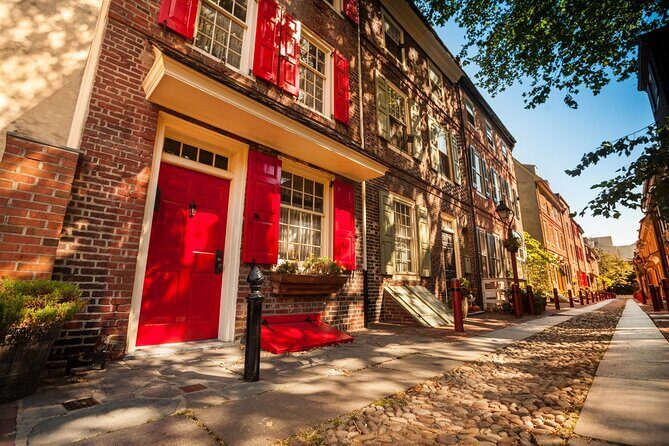
Next up is Elfreth’s Alley, Philadelphia’s historic street dating back to 1703. The street has 32 houses built between 1703 and 1836, and the alley is a National Historic Landmark. It’s one of those places where the buildings basically do half the storytelling for you.
In the game, you’re asked to look around again to find the answer that unlocks the next location. That turns Elfreth’s Alley from a photo stop into an active hunt. You’ll also pass close to the Elfreth’s Alley Museum area at #124 and #126, which is where the museum is located per the game’s details.
If you like small-scale history—old doorways, narrow lanes, and dates you can almost feel—this stop is a highlight. The alley is compact, so you can concentrate on the puzzle without feeling like you’re sprinting across town.
The financial muscle: the Second Bank of the United States
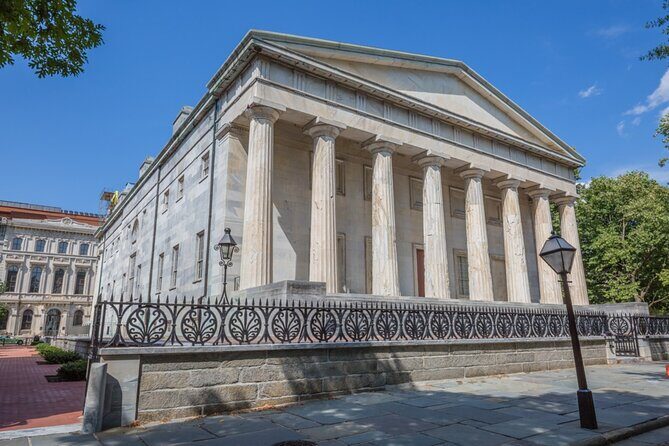
From the street-history narrow vibe, you shift toward early American institutions at the Second Bank of the United States. The game’s description frames it clearly: it was the second federally authorized Hamiltonian national bank, with a 20-year charter from February 1816 to January 1836.
What I like about including a bank in a walking mystery is that it breaks the usual Philadelphia pattern. Instead of only churches and presidents, you get a quick reminder that money and policy helped build the country too.
As with every other stop, the app turns the moment into a mini problem. Look around, find the clue, then move forward. If you’re someone who normally skips over government buildings because you think you’ll “catch up later,” this format nudges you to pay attention right now.
Independence Hall and the Constitution hub: the most serious stretch
Now comes the heavy-hitter section: Independence Hall, the National Constitution Center, and then the Liberty Bell prompt.
Other escape rooms and puzzle games we've reviewed in Philadelphia


Independence Hall: where the story is the point
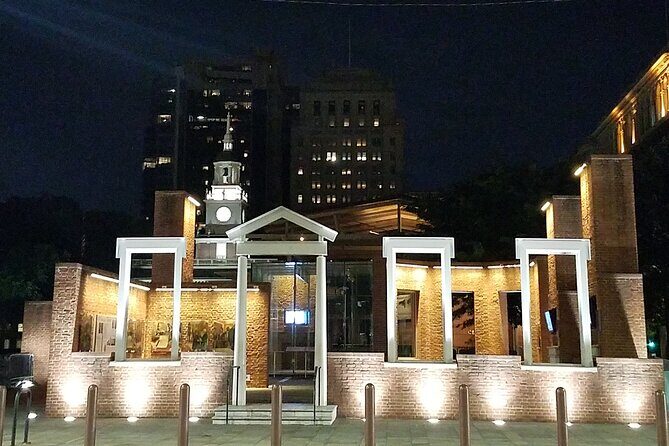
The game positions Independence Hall as the centerpiece where the Declaration of Independence and the U.S. Constitution were debated and adopted. It’s also a UNESCO World Heritage Site. Even when you’re not going inside (depending on what’s open on your visit), the location alone carries weight.
The puzzle aspect matters here because it keeps you from zoning out. You’re not just looking at a famous building. You’re searching for the answer the app is asking for, which tends to make people slow down and observe details they’d otherwise miss.
National Constitution Center: a nonprofit devoted to the Constitution
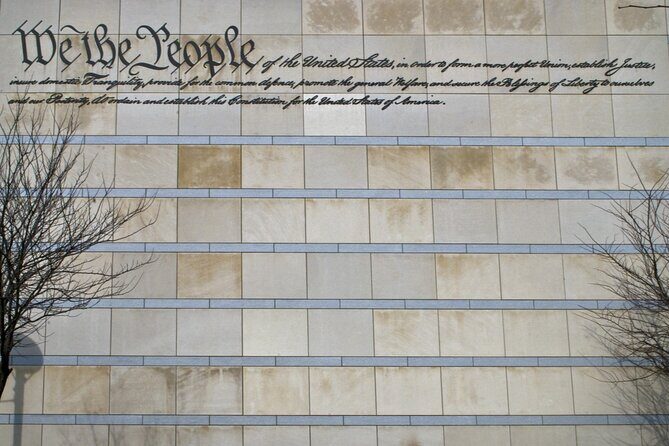
Just after, you’ll encounter the National Constitution Center, described in the game as a nonprofit devoted to the Constitution of the United States.
This stop works well in a puzzle format because it’s about concepts, not just architecture. The game nudges you to connect the setting with the idea of “what the Constitution is” instead of treating it as another “check the box” attraction.
Liberty Bell: independence you can see at street level
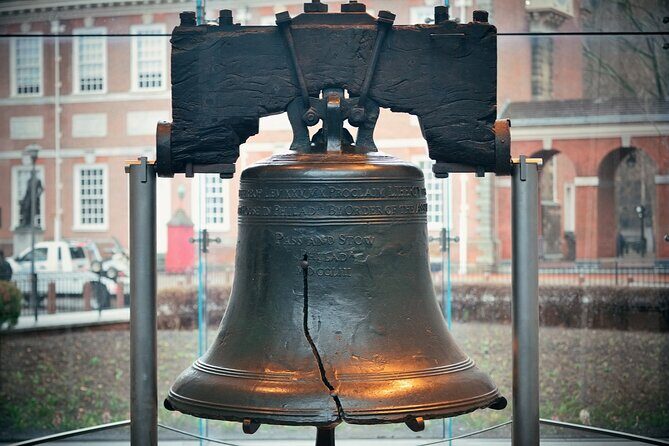
Then you get to the Liberty Bell, previously called the State House Bell or Old State House Bell. The app frames it as an iconic symbol of American independence.
This is where the walk pays off for first-timers. Most people already know the Liberty Bell is important. The game helps you experience it with more attention, so you leave with a stronger sense of why that bell is still one of the main symbols in American life.
Christ Church and Franklin’s burial ground: Georgian architecture and real names

After the Constitution stretch, the walk pivots toward early colonial religious life at Christ Church and then toward the graves connected to one of America’s best-known thinkers.
Christ Church (1695) and the Georgian building
Christ Church was founded in 1695 as the first parish of the Church of England in Pennsylvania. The current building was constructed between 1727 and 1744, moving from a smaller brick-and-wood structure to a grand Georgian architecture example.
In a puzzle walk, a church can become more than a quick look. If you’re willing to read the clues and scan details, you get a sense of time period and purpose that you might miss if you just rush for the next landmark.
Benjamin Franklin’s burial site: a cemetery with an extra layer
The next prompt focuses on the burial ground connected to Benjamin Franklin and his wife Deborah, plus the man who dug their grave. Christ Church acquired this burial ground in 1719, described as being on the outskirts of town because the churchyard cemetery was full.
This stop has a quieter, human scale. It’s not just founding-era big ideas. It’s people and the practical reality of how communities handled burial needs. The game’s clue style makes it easy to spend a few minutes absorbing what you’re seeing instead of treating it like a passing detail.
Chinatown to Reading Terminal Market: puzzles, food energy, and real community history
As you continue, the route touches Philadelphia’s Chinatown, and then it pushes you toward the big, lively finish at Reading Terminal Market.
Chinatown: a “bachelor society” origin story at 913 Race Street
The game gives Chinatown a specific origin: it was born in 1870 with a laundry at 913 Race Street, owned by Lee Fong. The story connects that to anti-Chinese sentiment in the west and people relocating east to form small “bachelor societies” in multiple cities.
This matters because it’s more than “culture on a map.” It’s a reminder that the neighborhood formed under pressure, with everyday work like laundries playing a role in community survival. The puzzle style keeps you from skimming past the significance.
Reading Terminal Market: a grid of stalls opened in 1893
Finally, the walk heads toward Reading Terminal Market at 1136 Arch St, which is also your tour endpoint. The game’s details paint the market as a major build: it opened in 1893 with about 78,000 square feet, nearly 800 spaces for merchants, and stalls about six feet each. The layout was a grid like Philadelphia’s street plan, with twelve aisles and four avenues.
I love a market finish after history walking. Your brain shifts gears. One moment you’re solving clues about government and architecture. The next, you’re thinking about lunch.
Even if you only have time for one snack, Reading Terminal Market is the right ending because it’s easy to reset. Pick a bite, people-watch, and let the walking settle your legs for the rest of the day.
The African American Museum stop: culture and context in a quick game moment
The game includes the African American Museum in Philadelphia, described as founded in 1976. It’s noted as the first major U.S. city institution built to preserve, interpret, and exhibit African-Americans’ heritage and culture.
In a short puzzle walk, this kind of stop is valuable because it adds perspective without turning your day into a long museum marathon. You get a focused moment of attention, and then you’re still on track for the market finish.
If you’re the type who likes learning in layers, this pairing works: history landmarks earlier, and then a museum prompt that broadens what “Philadelphia history” can include.
Price and timing: why this short mystery walk is good value
At $7.19 per person, you’re paying for a structured scavenger hunt across some top Philadelphia sights. You’re not paying for a guide’s interpretation time, and you’re not paying museum admission.
That’s why the flexibility matters so much. The experience is available 24/7, and you can start at any hour and pause whenever you want, then resume later. For real travel days—when you’re navigating crowds, transport, and hunger—that kind of freedom is often worth more than a “full service” tour.
The approximate duration of 1 hour 30 minutes is also a smart match for people who want iconic Philadelphia without burning a whole morning or afternoon. You can do it before dinner, or pair it with a longer food stop at the market.
Practical tips so the game doesn’t slow you down
This is a phone-first experience. So your success comes from setting up for smooth walking.
- Bring a fully charged phone. Even though you can play offline, your battery still pays the price.
- Expect some reading and scanning. These puzzles require you to look around, not just stand in one place.
- Wear shoes that handle uneven sidewalks and curb cuts. The route stacks multiple outdoor stops.
- If you’re visiting outside summer, treat Spruce Street Harbor Park as a “riverside boardwalk start” rather than a beach day.
And here’s a direct lesson from a problem that can happen: if you purchase through a third-party and the unlock link doesn’t work, you may have to buy again in the app that actually runs the program. If you want to avoid that headache, I’d recommend going straight to the Questo app route for purchasing and access.
Who this is best for (and who should skip it)
This walk is ideal if you like:
- A quick structure for first-time Philadelphia sightseeing
- Learning by doing—solving clues at each landmark
- Outdoor walking that mixes famous and less-frequently-noticed spots
You might not love it if:
- You prefer deep narration from a person, not a phone prompt
- You want museums with longer timed visits built in
- You don’t like puzzle mechanics at all and would rather just read plaques
Should you book Solve the Case in Philadelphia?
If you want a budget-friendly way to hit Independence Hall, the Liberty Bell, Christ Church area, and Reading Terminal Market in one smooth flow, this is a solid pick. The offline directions and pause-and-resume flexibility make it easy to plan around real life, not just an itinerary.
But be honest with your style. If you love a little “find the answer” momentum while sightseeing, you’ll likely enjoy this. If you want a guide to answer questions on the spot, you’ll probably feel limited without one.
FAQ
FAQ
What is this experience, exactly?
It’s a self-guided mystery puzzle walk in Philadelphia run through the Questo app. You follow step-by-step directions and solve challenges at each location to advance.
How long does the walk take?
The experience is listed at about 1 hour 30 minutes.
How much does it cost?
It costs $7.19 per person.
Can I play it offline?
Yes. The experience is designed so you don’t need an internet connection while exploring.
Where does the walk start and end?
It starts at Spruce Street Harbor Park (301 S Christopher Columbus Blvd, Philadelphia) and ends at Reading Terminal Market (1136 Arch St, Philadelphia).
Is there a physical tour guide with you?
No. It’s guided step by step through the Questo app, so you don’t have a physical tour guide.
What language is it offered in?
It’s offered in English.
Is it available at any time?
Yes. It’s permanently available, 24/7, every day of the year.
Is it suitable for kids?
Yes. It’s free for kids.
Are service animals allowed?
Yes, service animals are allowed.
Can I cancel if my plans change?
Yes. You can cancel for a full refund up to 24 hours before the experience’s start time.