REVIEW · PHILADELPHIA
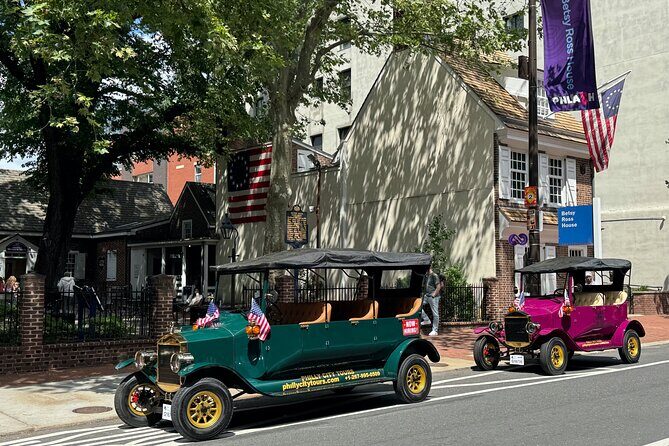
Explore Philadelphia via Vintage Car or Electric cart
Book on Viator →Operated by Philly City Tour · Bookable on Viator
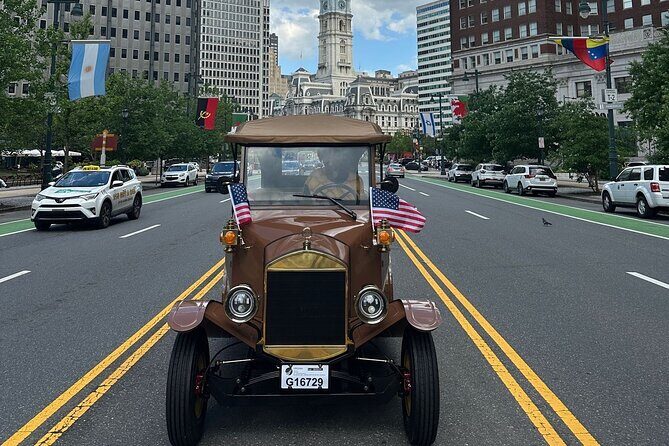
Philadelphia shows off fast on this tour. This vintage car or electric cart ride turns a lot of Philly highlights into a single, guided afternoon loop. You’ll hear stories as you go, then hop out for quick looks and photos at the places people come from all over to see.
I love the photo-friendly timing. You get enough time at each stop to take pictures and actually absorb what you’re looking at, instead of feeling rushed through everything. I also like the mix: big-name monuments like Independence Hall, plus offbeat stops like Philadelphia’s Magic Gardens and old streets like Elfreth’s Alley.
One thing to consider is sightlines. Some vehicles can make it harder to see if the top cover sits low, and if you’re taller, you’ll want to ask ahead about the best seating. The good news: guides can often help adjust the setup so you can see and shoot photos comfortably.
In This Review
- Key Highlights That Make This Tour Worth Your Time
- Why This Vintage Car or Electric Cart Tour Works in Philly
- Duration, Group Size, and What to Expect From the Pace
- Starting at City Hall: The 22-Foot Walls and William Penn’s Crown
- Philadelphia Museum of Art in 15 Minutes: The Shortcut That Still Counts
- Magic Gardens: How a Vacant Lot Became a Mosaic World
- Memorial Stops: Vietnam Veterans and the Korean War Memorial
- Betsy Ross House and Elfreth’s Alley: Early Philly in Small, Real Spaces
- Liberty Bell Center and Independence Hall: The Two Stops You’ll Feel in Your Chest
- U.S. Mint, National Constitution Center, and Why These Stops Add Context
- Chinatown and the Historic Market: Fast Food Options That Feel Local
- Price Value: Is $55.20 for 2 Hours a Good Deal?
- Getting the Best View From Your Car or Cart
- Should You Book This Philadelphia Highlights Tour?
- FAQ
- FAQ
- How much does the Philadelphia vintage car or electric cart tour cost?
- How long is the tour?
- Does the tour offer pickup?
- What language is the tour in?
- What’s included in the price?
- Are admission tickets included for museums and historic sites?
- Which stops have free admission?
- Is the tour suitable for most people?
- What’s the maximum group size?
- What if weather is bad?
- Can I cancel and get a full refund?
Key Highlights That Make This Tour Worth Your Time
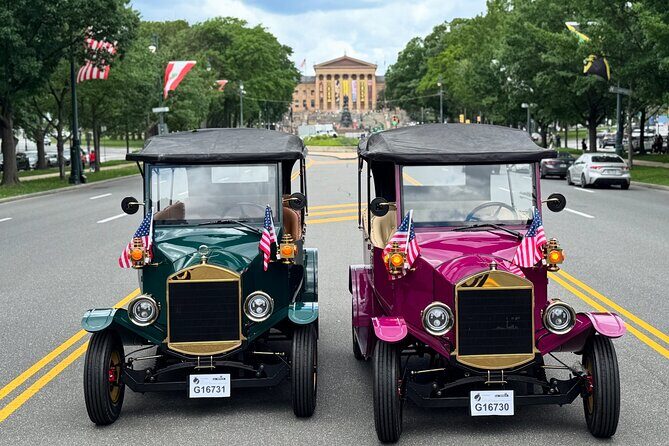
- A vintage car or electric cart route that hits major Philly landmarks in about 2 hours
- Guides who keep the mood fun, including big personality names like Andy, Shane, Parsa, and Chaynj in recent trips
- Short, workable stop lengths that let you see a lot without losing the whole day to planning
- A strong blend of stops: world-famous history (Independence Hall, Liberty Bell) and visual art (Magic Gardens)
- Free memorial and landmark stops mixed in so you can save money on admissions
- Quick photo breaks where you can step out, stretch legs, and grab good angles
Why This Vintage Car or Electric Cart Tour Works in Philly
Philadelphia can be a bit tricky if you’re short on time. The city is spread out, parking can be annoying, and many of the top sites are ticketed or have limited hours. This is why I like a guided loop like this: it compresses the “where do I go first?” problem into one smooth plan.
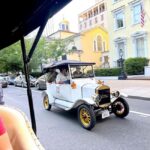
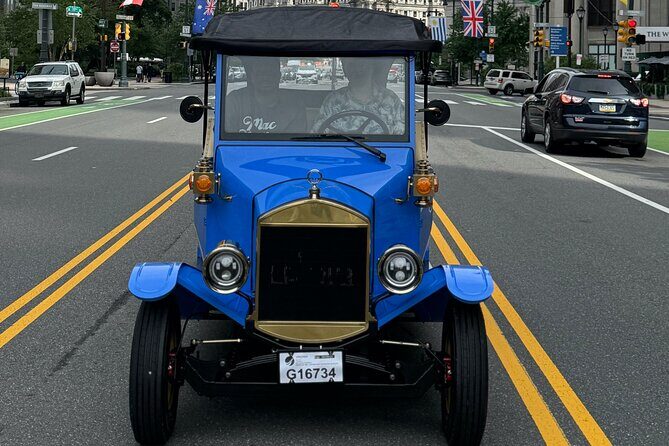
Riding in a vintage car (or an electric cart, depending on the vehicle used) also changes the feel. You’re not stuck walking in one long line. Instead, you get movement, local commentary, and quick exits at the right moments. It’s especially useful for first-time visitors who want their bearings—fast—without turning the trip into a checklist.
One more practical win: the route is designed around major landmarks that are close enough to connect by car, but varied enough that you don’t feel bored watching the same kind of scenery. You’ll see grand stone and official buildings, then pivot to art made from broken tiles and found objects, then shift again to quiet memorials that deserve a slower pace.
Other electric cart and vintage car tours we've reviewed in Philadelphia
Duration, Group Size, and What to Expect From the Pace
Plan on about 2 hours total. That’s not a full-day tour, and it isn’t meant to replace deeper museum visits. It is meant to help you see a lot of Philly’s headline locations in one go, then decide what you want to revisit later on your own.
The group stays fairly small, with a maximum of 22 people. In real life, that usually means you can hear the guide when you’re stopped and you can get in and out for photos without a constant bottleneck. It also makes it easier for the guide to adapt the pace if someone in your group needs extra time.
The stop lengths vary, but several key points are brief—think 10–15 minutes for the heavier “wow” locations, and shorter hangs at places like the Liberty Bell and Independence Hall. If you want long, sit-down time inside buildings, you should treat this as the fast introduction. Your “homework” after the tour is simple: pick your top two or three places and go deeper.
Starting at City Hall: The 22-Foot Walls and William Penn’s Crown
Your tour kicks off in the shadow of Philadelphia City Hall, and it’s hard not to feel like you’re standing next to something made to last forever. The stories here are the kind that make the building feel like a character: it took 30 years and cost $25 million back then, and the walls are 22 feet thick, built from solid stone.
Then comes the skyline fact that turns heads. Completed in 1901, City Hall stood as the tallest building in the world at 548 feet, and it still holds the title for the tallest masonry building. Up top is the 37-foot statue of William Penn, described as the largest statue atop any building in the world.
Why I think this matters for you: this stop gives you a frame for what Philly values—monumental buildings, civic pride, and craftsmanship you can read in the stone. Even if you’ve walked by City Hall before, you’ll likely leave seeing it differently once you understand the scale and the design intent.
Philadelphia Museum of Art in 15 Minutes: The Shortcut That Still Counts
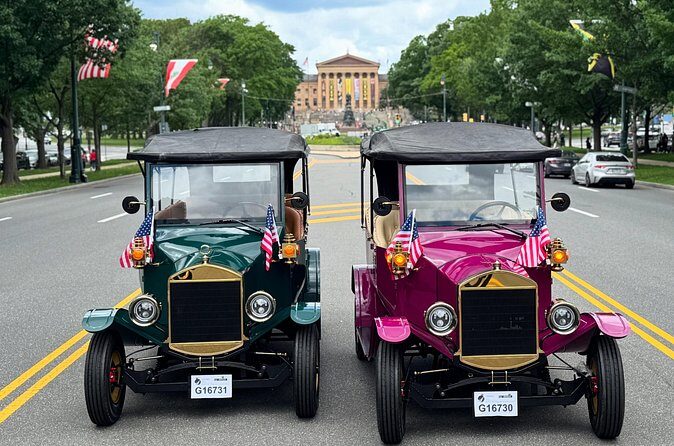
You’ll spend about 15 minutes at the Philadelphia Museum of Art (PMA). That’s not enough time to see the museum end-to-end, but it is enough time to orient yourself and decide whether you want to come back later for a longer visit.
PMA’s origin story helps. The museum was chartered in 1876 for the Centennial Exposition in Philadelphia, and today it administers collections with over 240,000 objects across major holdings from Europe, America, and Asia. In other words, the museum isn’t just a pretty exterior—it’s a serious collection.
The realistic way to enjoy the museum on this tour: treat it like a tasting menu. You’re looking for a couple of pieces or a single theme you want to find later. If you only have one afternoon, this stop still gives you a reason to care, without demanding a half-day commitment.
Note on logistics: admission tickets are not included for this stop, so you’ll want to budget for it if you plan to go inside. The upside is you can still use the time to take in the setting around the museum even if you decide not to ticket up.
Magic Gardens: How a Vacant Lot Became a Mosaic World
Philadelphia’s Magic Gardens is one of those places you can’t fully describe until you’re standing in it. It’s the mosaic work of Isaiah Zagar, built starting in the 1990s. What started as a vacant lot on South Street became a massive mosaic maze made from tiles, glass, mirrors, and found objects.
You’ll have about 10 minutes here. That short window is a good match to the experience because it forces you to pick what you’ll notice first—patterns, colors, textures, or the way the space seems to fold in on itself.
You should know the practical piece: admission tickets are not included for this stop. If you’re the kind of person who loves art-as-place (not just art-as-gallery), it’s worth considering a return when you have more time and can wander slowly.



Memorial Stops: Vietnam Veterans and the Korean War Memorial
Not every stop here is designed to entertain. Two of them ask you to slow down: the Philadelphia Vietnam Veterans Memorial and the Philadelphia Korean War Memorial. Both are free, and each includes about 10 minutes on site.
The Vietnam memorial, dedicated in 1987, lists 646 names of Philadelphians who died in the Vietnam War. It also includes engraved scenes from the conflict and references the large number of soldiers lost, with many described as young (age 20 and below).
The Korean War memorial was added in 2002 and features black granite pillars that honor 610 fallen service members from Philly and nearby counties. It also shares a broader loss context for the conflict.
My take on value for you: these are meaningful stops you can’t really recreate on a quick self-guided drive-by. The guide’s context helps you see that these aren’t just monuments—they’re records of people. And because the time is brief, you’re less likely to get stuck in a “too much at once” emotional overload.
Betsy Ross House and Elfreth’s Alley: Early Philly in Small, Real Spaces
After the memorial weight, the tour shifts into older streets and legendary stories.
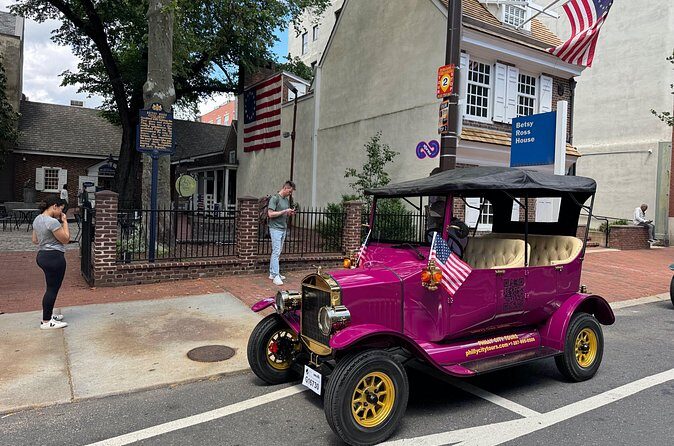
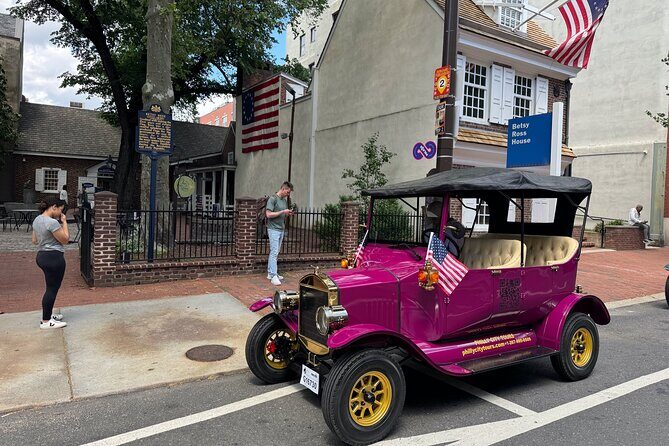
First up is the Betsy Ross House, a row home built in 1740 and restored to about the year 1777. It’s tied to the legend that in 1777, Betsy Ross was commissioned by George Washington to create the first American flag. Your time here is short—about 5 minutes—so it’s mainly about seeing the restored setting and understanding why the site matters in American folklore.
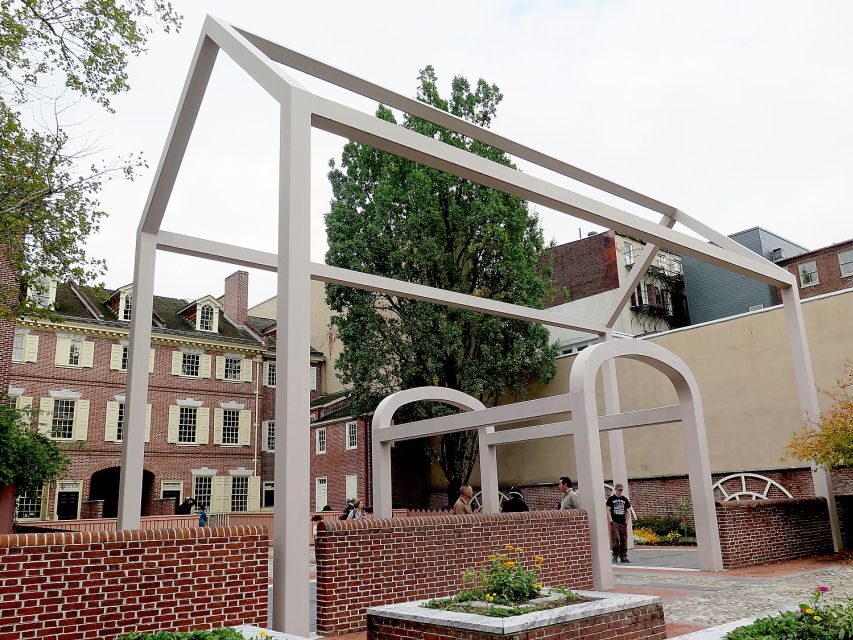
Then you hit Elfreth’s Alley, built in 1702. This is described as the oldest continuously lived-on residential street in America, with 32 charming brick houses from the 1700s and early 1800s. Expect cobblestone-like street character and colonial-era home lines, and you’ll have about 5 minutes to take it in. There’s also the option to visit the Elfreth’s Alley Museum to see inside two preserved homes and learn daily-life details.
Both of these have a practical rhythm:
- Betsy Ross House is a quick history hit.
- Elfreth’s Alley is where you slow down visually, because the street itself tells the story.
Cost note: Betsy Ross House admission is not included, while Elfreth’s Alley is free (including the listed museum option during your stop).
Liberty Bell Center and Independence Hall: The Two Stops You’ll Feel in Your Chest
If Philly has a “core,” this is it.
You’ll pause at the Liberty Bell Center for about 5 minutes. This is where the famous bell associated with the Pennsylvania State House (today Independence Hall) was used for public announcements. The bell is described as having rung for the first public reading of the Declaration of Independence on July 8, 1776, and it was silenced by a crack in 1846.
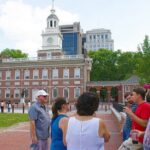
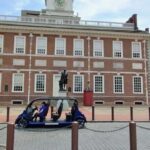
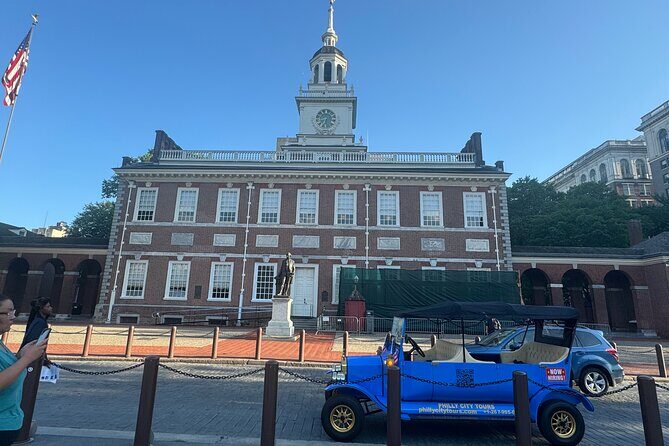
Then comes Independence Hall itself. You get about 5 minutes there, and it’s one of those stops that changes the way you read American history. Independence Hall was built in 1732 as the Pennsylvania State House. The tour highlights that the Second Continental Congress met in May 1775, the Declaration of Independence was adopted on July 4, 1776, and the Constitution Convention met in 1787 to draft, debate, and sign the Constitution.
Ticket note: Independence Hall admission is not included. That’s important. Even if the exterior is powerful, the real payoff is what you’re able to do inside depending on your ticket status and what’s open on your date.
One more reality check: if an official site is closed due to scheduling changes, you may not get the full intended experience. Still, the guide can help you make the most of the time you do have.
U.S. Mint, National Constitution Center, and Why These Stops Add Context
You’ll also stop at the United States Mint in Philadelphia, one of the oldest and most iconic U.S. institutions. It was established in 1792 and is the largest of the four active U.S. mints. During your time there, you’ll learn that it produces circulating coins, commemorative coins, and medals—on a scale described as billions of coins.
Another stop is the National Constitution Center, located on Philadelphia’s Independence Mall. This museum is described as the first in the world devoted to telling the story of the U.S. Constitution from Revolutionary times to the present, using more than 100 interactive and multimedia exhibits, plus film, photographs, text, sculpture, and artifacts.
Even if your time at each stop is brief, these two locations make the bigger history feel less like a set of dates. Instead, they show how the ideas of a new country became real institutions—money, documents, and public storytelling.
Chinatown and the Historic Market: Fast Food Options That Feel Local
Philadelphia isn’t just about monuments. Your route also threads through Chinatown, rooted in the 1870s and 1880s when Chinese immigrants arrived. Today it’s described as having multiple Asian community connections across cultures like Korea, Thailand, and Vietnam. It’s a neighborhood with shops and food options, plus cultural events.
Then you’ll reach a major historic public market housed since 1893 in a National Historic Landmark building. It includes 70+ family-owned small businesses. The market is described as a strong mix of locally grown produce, meats and poultry, plus seafood, cheeses, baked goods, and confections.
Why this matters on a tight 2-hour schedule: this is where you can grab something quick without spending your afternoon hunting for lunch. If you’re the type who likes one food stop as a souvenir, this is the place.
Price Value: Is $55.20 for 2 Hours a Good Deal?
At $55.20 per person for about 2 hours, the value depends on what you want most.
If your top priority is saves-time sightseeing—big landmarks, art stops, memorial context, and a guide to connect the dots—then this can be a solid value. You’re paying for transportation between sites and for the guided storytelling that helps the city make sense quickly.
Where the math changes for you: admission is not included for several major stops like the Philadelphia Museum of Art, Philadelphia’s Magic Gardens, Betsy Ross House, and Independence Hall. Some memorial and landmark stops are free (Vietnam Veterans Memorial, Korean War Memorial, Elfreth’s Alley, Liberty Bell Center). So your total cost can rise if you decide to go inside the ticketed attractions.
My advice: treat the tour as the plan, not the entire trip. Come prepared to pay for one or two admissions you care about most, and skip the rest if you’re trying to keep the day affordable.
Getting the Best View From Your Car or Cart
This tour is fun partly because you can see things while moving, not just standing still. But sightlines vary by vehicle and seat position.
If you’re taller, or you’ve got trouble seeing from low seats, ask ahead for the best seating option. The tour’s vehicle setup can include a top cover that may lower into your view, and a fix is sometimes possible—your guide can remove the top cover upon request if it affects visibility.
Also, dress for the weather. One of the best pieces of feedback I saw was how guides handled freezing conditions and kept families comfortable, including making sure a very young child stayed warm. Philly in winter can be raw fast, so plan for it.
Should You Book This Philadelphia Highlights Tour?
Book it if you want a fast, guided introduction to Philly’s key sights—especially if you’re here for a limited window and you want the city to feel connected, not chaotic. It’s also a good match for families and couples who like photo breaks and don’t want to spend the whole day inside ticketed attractions.
Skip it (or plan a second day) if your goal is deep, slow museum time. This tour is short, and many ticketed stops are brief. You’ll likely leave with a list of places you want to revisit—and that’s not a bad thing. It just means this is step one, not step five.
FAQ
FAQ
How much does the Philadelphia vintage car or electric cart tour cost?
The price is $55.20 per person.
How long is the tour?
The tour runs for about 2 hours.
Does the tour offer pickup?
Yes, pickup is offered. If you’re meeting instead of being picked up, the start point is 51 N 12th St, Philadelphia, PA 19107, and you should look for the Philly City Tours sign.
What language is the tour in?
The tour is offered in English.
What’s included in the price?
The tour includes a vintage car (as stated in included items) and a guided tour.
Are admission tickets included for museums and historic sites?
No. Admission tickets are not included for several stops such as the Philadelphia Museum of Art, Philadelphia’s Magic Gardens, Betsy Ross House, and Independence Hall. Some memorials and landmarks are listed as free.
Which stops have free admission?
The Philadelphia Vietnam Veterans Memorial, the Philadelphia Korean War Memorial, Elfreth’s Alley, and the Liberty Bell Center are listed as free.
Is the tour suitable for most people?
Most people can participate.
What’s the maximum group size?
The tour has a maximum of 22 travelers.
What if weather is bad?
This experience requires good weather. If it’s canceled due to poor weather, you’ll be offered a different date or a full refund.
Can I cancel and get a full refund?
Yes. You can cancel up to 24 hours in advance for a full refund. If you cancel less than 24 hours before the experience starts, the amount paid will not be refunded.